

Belgian Endive
Bitter by Nature, Grown in the Dark, All Year Round

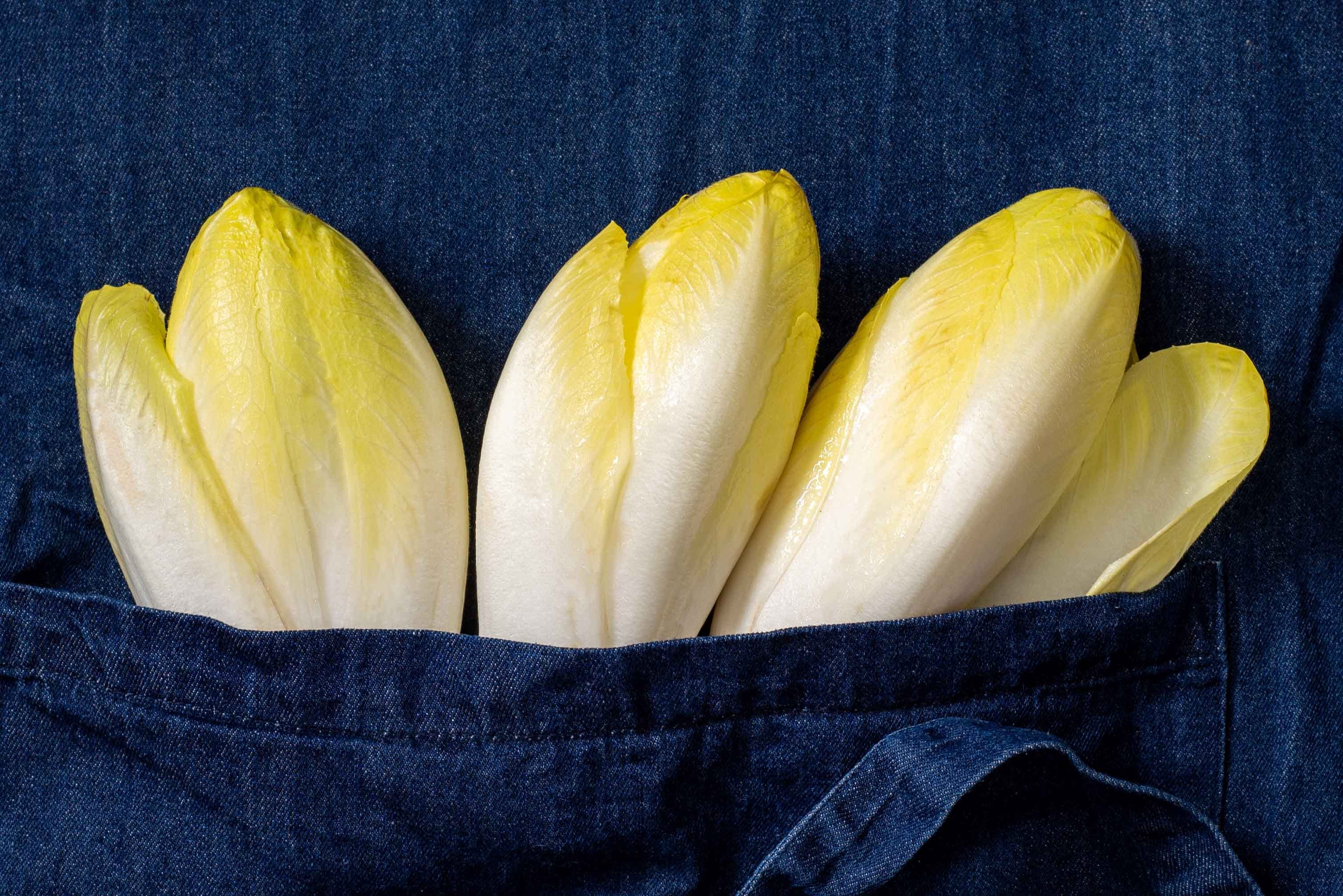
You can say many things about Belgian endive, but not that it is universally loved. Children in particular often need time to get used to its flavour and to learn how to eat it. Yet once you discover its qualities, you quickly realise that Belgian endive offers far more than the familiar baked dish or raw salad. Think stir-frying, grilling, roasting, braising or slow-cooking. We will be working with Belgian endive in the kitchen, but first we take a closer look at its unusual growing process.
What is Belgian endive?
Belgian endive is a leafy vegetable that develops as a shoot on the root of chicory. Chicory has several well-known bitter relatives in the kitchen, including endive, radicchio and red chicory. Together, they belong to the Asteraceae family. Chicory roots resemble thick parsnips. In The Netherlands, they are grown in summer on open fields (among others in Zeeland, Drenthe and the Noordoostpolder) and harvested in autumn. Some chicory varieties are used to produce coffee substitutes. Others serve as a source of the natural dietary fibre inulin, from which fructose (a monosaccharide) can be derived. And, of course, chicory roots are essential for growing Belgian endive.
Like pencils in a tray
The foundation of Belgian endive lies in the chicory roots. After harvest, these roots are stored in crates at just below freezing temperature. The leaves are used as animal feed or green manure. The roots, referred to by growers as forcing roots, can be stored this way year-round and used as needed for cultivation.
The forcing process works as follows. The roots are placed upright in trays, with the cut end facing upwards. The trays are stacked and transferred to dark growing cells. There, they are connected to an irrigation system that continuously supplies flowing water to the base of the roots. During growth, this water is circulated in a closed system. Nutrients can be added to the water, known as the substrate, to stimulate growth. This is not essential, and is not used in organic cultivation, because the forcing root already contains all the nutrients the plant needs.
When the roots are moved from cold storage into the dark cell, the temperature rises from below zero to around 20°C. In the absence of light, the roots start producing shoots, as they “assume” they are still underground. After four weeks, the heads are fully grown. The grower cuts the heads from the roots and the endive is packed.
If you would like to see how Belgian endive is grown in practice, watch this video we made during a visit to organic Belgian endive grower Krops in the Noordoostpolder in The Netherlands.
A bitter taste
Many plants produce bitter compounds to make themselves less attractive to insects and animals. Chicory naturally contains high levels of such compounds (lactucin and lactucopicrin) and these are also present in Belgian endive. Growers can influence bitterness in several ways: through the choice of chicory variety, but also by adjusting growing conditions such as temperature and water supply.
Growing Belgian endive in the dark does not affect bitterness, but it does prevent the leaves from turning green, as light would trigger chlorofyl formation. It is often said that Belgian endive used to be more bitter in the past, just like Brussels sprouts. That is true: selective breeding has led to varieties with reduced bitterness.
Poison is normal
Bitterness is a fascinating taste, because we are naturally inclined to dislike it. That makes sense: in nature, bitter flavours often signal toxic substances. As a result, humans have dozens of different receptors for detecting bitternes, far more than for the basic tastes sweet, sour and salty.
There are ways to soften or mask bitterness. Some bitter flavours can be effectively neutralised with acidity. Campari or Aperol mixed with lemon juice, for example, lose much of their bitterness due to the acid. Caramelising Belgian endive with orange juice has a similar effect. We apply this technique in the recipe for noodles with stir-fried Belgian endive later in this newsletter.
Salt can also suppress the perception of bitterness by adding flavour and shifting attention away from the bitter notes. In our savoury Belgian endive tart (also included in this edition), we use anchovies instead of salt.
This concludes the free section of this newsletter. Would you like to learn more about cutting and cooking techniques for Belgian endive and start working with the recipes below? Continue reading in the paid section.
Not a member yet? Subscribe to our newsletter. Note: Subscribe via our website to avoid extra App Store fees. Through kitchenlab.substack.com/subscribe you pay €60 per year or €6 per month. Through the Substack app, you pay €85/€ 9 due to Apple’s service fees.
As a subscriber, you’ll receive the full Kitchen Lab newsletter every other Sunday (in your inbox or on Substack). You’ll also get access to all our newsletters, including the archive. Plus, members can ask questions and share recipes or information in the Kitchen Lab Chat.


